Binder Constant Climate Chambers with Light: Photostability Testing with an All-New Light Source According to ICH Q1B
According to the CPMP / ICH / 279/95 Q1B guideline from 1996, the procedure for conducting photostability testing on new active substances and medicinal products is specified as follows:
- White fluorescent lamps must comply with the ISO 10977 (1993) standard
- UVA fluorescent lamps have a spectral range from 320 nm to 400nm with maximum energy emission between 350 nm and 370 nm. The commonly used spectral range usually falls between 320 nm to 360nm and 360nm to 400nm.
- Samples must be exposed to visible light (VIS) for at least 1,2 million lux·h and UVA for at least 200 W/m2.
The specifications listed above are widely used. However, there are more stringent photostability tests when using chambers with lighting equipment compliant with the ICH Q1B guideline.
This article introduces two light photometric methods for ICH Q1B compliant photostability testing and reviews their key advantages and disadvantages.
So, is a flat or spherical light sensor better?
Two types of light sensors commonly found in ICH Q1B photostability testing are flat sensor surface meters (flat sensors) and spherical sensor surface meters (spherical sensors). There are two main differences between them: one sensor calculates the irradiance, while the other measures actual irradiance.
Lambert's cosine law states that radiant intensity decreases as angles become more oblique. To compensate for this decrease, flat sensors with diffusers use cosine correction. This means that only a small proportion of radiation striking the sensor surface is actually measured – radiation striking at a 90° angle. For all other angles of incidence, radiant intensity is calculated using a mathematical equation.
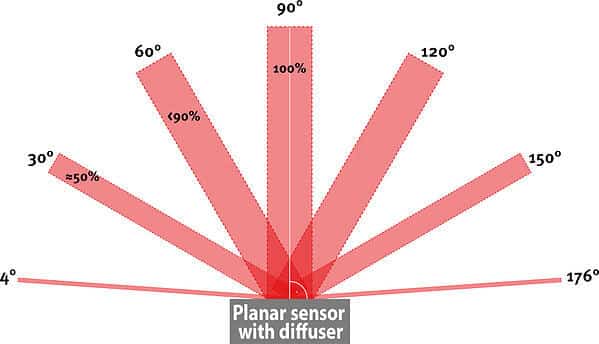
Figure 1 shows that light radiation reaches its maximum level when the angle of incidence is at 900 relative to the contact surface.
At an angle of incidence of 0° or 180°, radiation from the incident light source is completely unrecorded. In addition, it cannot record any radiation from below.
In complete contrast to this, the spherical sensor measures the actual radiation intensity from all directions, meaning it even captures scattered radiation. Radiation always hits the sensor at a 90° angle, eliminating the need for cosine correction. The actual radiation intensity is measured, not calculated.
This is why BINDER constant climate chambers do not use flat sensors with diffusers for photostability testing of new active substances and drug products. The same applies to flat sensors without diffusers, as they record less than the actual radiation intensity.
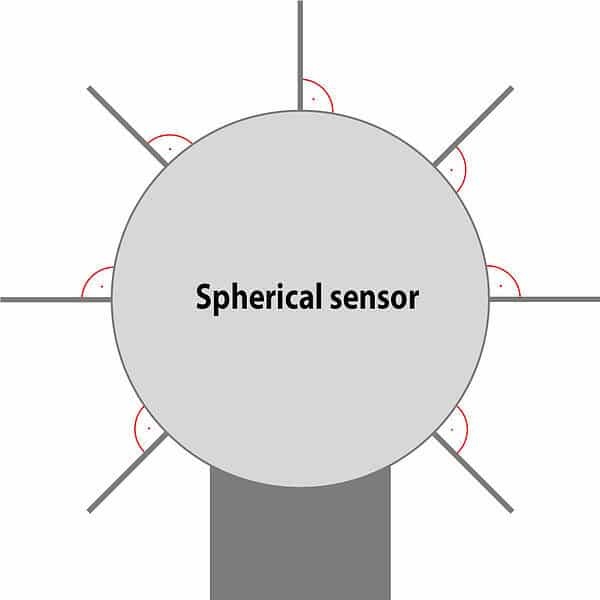
Spherical sensors are the only sensor type that can measure radiation intensity and record scattered radiation. BINDER has been using freely positionable spherical sensors in the KBF LQC 240, KBF LQC 720 constant climate chambers with light for many years.
LQC stands for Light Quantum Control™ and is Binder's patented photometry method for photostability testing.
For sample photostability testing according to ICH Q1B, the UV and VIS light intensity must be precisely determined per unit of time. Visible light (VIS according to ISO 10977 (1993)) must achieve an exposure of at least 1,2 million lux-hours, and UV light (320nm to 400nm) must achieve at least 200 Wh / m2.
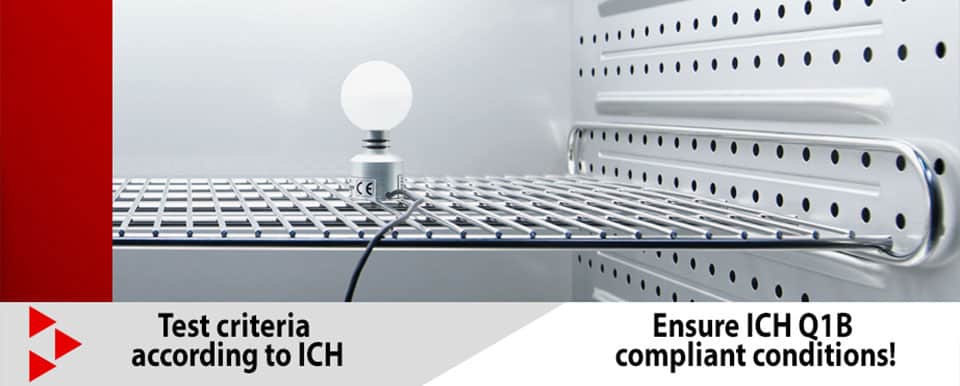
Two spherical sensors can be freely positioned inside the chamber—making them easy to move to avoid contact with samples (Figure 3)—to control the amount of UV and VIS light. The unit automatically turns off the internal lamps once the preset energy level is reached, helping to prolong the light source's service life and allowing users to stay proactive during sample testing.
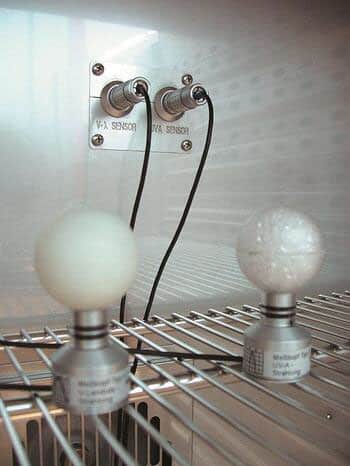
The freely positionable sensor design is one of BINDER's brilliant innovations to prevent testing results from being affected by samples placed too close to or touching the sensors.
ICH-compliant illumination
VIS light is generated by rod-shaped bright white T8 fluorescent tubes with a diameter of 26 mm. The emission range is from 400 nm to 700 nm. The spectral range conforms to the F6 standard (cool white) according to ISO 10977. Depending on the intended use, the length can be 600 mm or 900 mm.
The UVA element is generated by T8 rod-shaped fluorescent tubes with a diameter of 26 mm. The emission range is between 320 nm and 400nm, between 400 nm and 700 nm. Depending on the intended use, the length can be 600 mm or 900 mm.
The UVA fluorescent lamps (BINDER Q1B Synergy Light) switch off independently of the white light fluorescent lamps once the set energy dose according to CPMP / ICH / 279/95 (Q1B) is reached.
BINDER constant climate chambers with light do not use dimmable fluorescent lamps, as dimming often leads to changes in the spectral distribution.