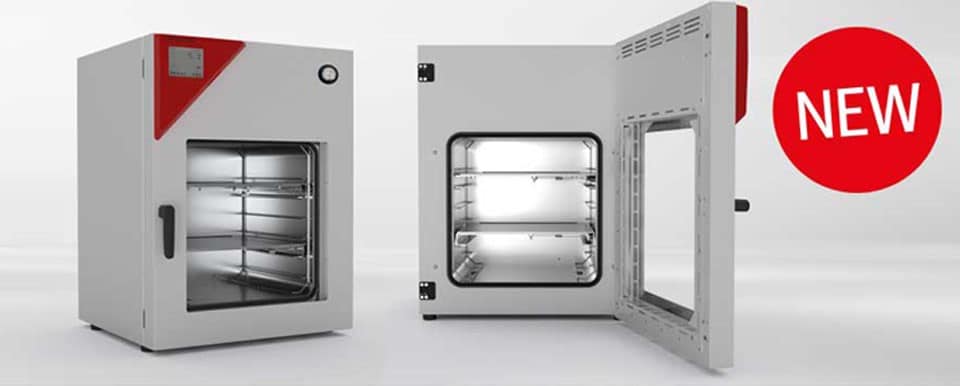
6 key points customers should consider when purchasing a climatic chamber (accelerated aging chamber) – Point 1

Continuous and smooth operation of climate chambers is a prerequisite for long-term product stability testing according to ICH guidelines or real-time sample testing over months or years
Which current technical solutions can guarantee reliability during continuous operation?
Which factors should you pay special attention to, and what are the advantages and disadvantages?
This guide provides answers for users through the following 6 topics:
- Climatic zone
- Airflow
- Water for humidifier
- Light
- Continuous operation
- Programming and documentation
Point 1: Climate zone
In addition to climate zones, spatial deviations inside the chamber and deviations over time also play an important role.
Particularly important is temperature uniformity inside the chamber. This helps users simulate the climate of their required zone; additionally, Binder excels in stress testing, a test requiring high temperature and high humidity
Climate simulation refers to controlling temperature and humidity. For example, setting 40°C temperature and 75% relative humidity
Temperature and humidity charts provide quick information on the overall performance of a climate chamber, also known as an accelerated aging chamber.
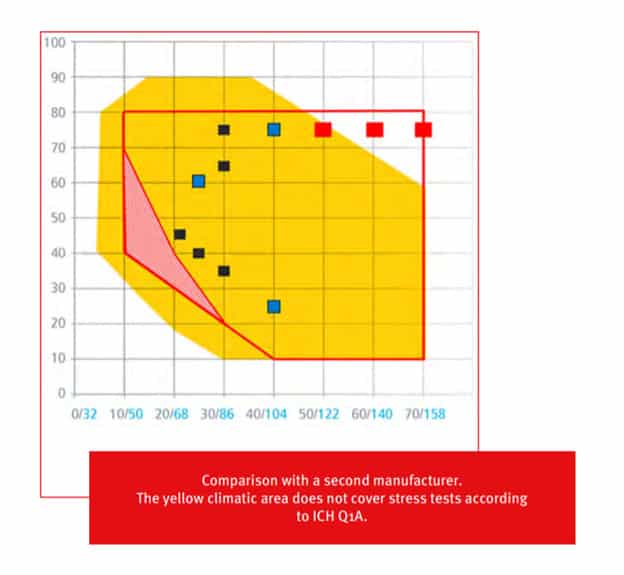
Figure 1: Comparison between the operating ranges of climatic chambers from 2 different brands. Yellow fails in the test zone for the Stress test parameter according to ICH Q1A standards. Binder brand in red can perform Stress testing with high efficiency
For climate chambers, besides selecting the appropriate climate zone, there are also specifications for temperature uniformity and time fluctuations inside the chamber
They are determined according to DIN 12880: 2007 standards with 27-point measurement as follows.
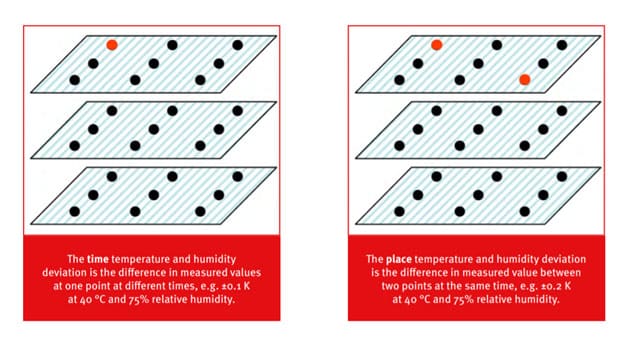
Figure 2.1: Deviation at 1 point over time under constant temperature and humidity, for example: deviation is ±0.1K at 40°C temperature and 75% relative humidity
Figure 2.2: Deviation between 2 points at the same time under temperature and humidity, deviation is: ±0.2K at 40°C temperature and 75% relative humidity
A manufacturer calibration certificate is available for temperature and humidity uniformity values
For climate chambers with performance data related to ambient temperature (e.g. ambient temperature +10°C to 70°C) or ambient conditions up to 95% RH, the technology is not designed for safe climate simulation, e.g. for climatic zones I to IVb. The actual climate values depend heavily on the conditions in the installation room, which is why such models are not recommended for long-term stability testing.
Note that the manufacturer's temperature and humidity specifications refer to an unloaded or empty chamber interior. When loaded, the type of air ducting is of particular importance.