6 Key Points Customers Should Consider When Buying a Climate Chamber (Accelerated Aging Chamber) – Point 3
Continuous and smooth operation of the climatic chamber is a prerequisite for long-term product stability testing according to ICH standards, or real-time sample testing over months or years.
Which current technical solutions can guarantee reliability during continuous operation?
Which factors should you pay special attention to, and what are the advantages and disadvantages?
This guide provides answers for users through the following 6 topics:
- Climatic zone
- Airflow
- Water for humidifier
- Light
- Continuous operation
- Programming and documentation
Point 3: Water for the humidifier
Connection to an on-site water supply and drainage system requires a supply pressure of 1 to 10 bar and a temperature not lower than +5°C and not higher than +40°C. Water is pumped automatically.
Two large-volume water tanks are mounted directly onto the climatic chamber: one for water supply and one for drainage. Supplied as accessories. The climatic chamber is installed independently of fixed water supply and drainage systems. If the water supply tank runs out of water, the system triggers an alarm on the controller display.
Water consumption depends on the humidity setpoint and the frequency of door openings. Used water should not be reused to supply the humidifier, as used water contains undesirable components.
Steam humidifiers and ultrasonic humidifiers are the most common types of humidifiers.
A good humidification unit accurately maintains the boiling point of water, thereby immediately providing humidity when needed. Humidification water is continuously sterilized at 100°C, minimizing the risk of biological contamination and ensuring no standing water during operation. The ultrasonic humidifier generates ultra-fine droplets (no aerosol formation) that are introduced into the chamber and evaporate there. To avoid lowering the temperature inside the test chamber (evaporative cooling), reheating is required. A tray is provided to catch water dripping from the humidification unit.
Dehumidification is achieved by dropping below the dew point at the heat exchanger. Precise measurement and control technology ensures stable climatic parameters.
Particular attention must be paid to the quality of the water supplied to the climate chamber, which must meet specified standards. Water conductivity must be between 1 µS/cm and 20 µS/cm. If the water quality does not meet the requirements, water treatment is required prior to use. An ion-exchange water purification system is a suitable choice. The lifespan of the humidifier depends on the water quality and water consumption level.
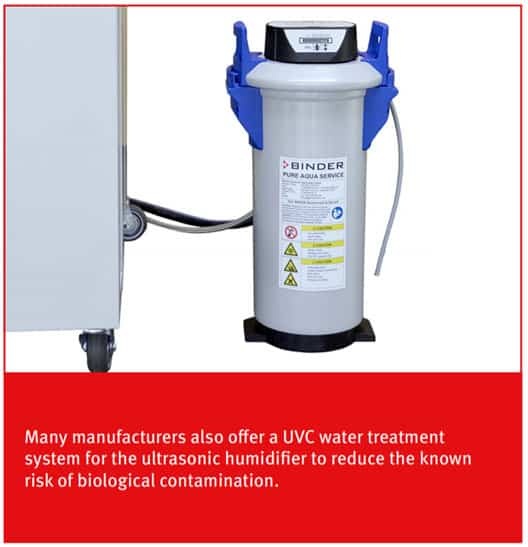
Image of UVC water supply system for ultrasonic humidifiers to reduce microbial contamination in the humidifier.