6 important points customers should consider when buying a climate chamber (Accelerated stability test chamber) – Point 4
Continuous and smooth operation of the climate chamber (accelerated stability test chamber) is a prerequisite for long-term product stability testing according to ICH standards, or real-time sample testing over many months or years.
Which current technical solutions can guarantee reliability during continuous operation?
Which factors should you pay special attention to, and what are the advantages and disadvantages?
This guide provides answers for users through the following 6 topics:
- Climatic zone
- Airflow
- Water for humidifier
- Light
- Continuous operation
- Programming and documentation
Point 4: Light
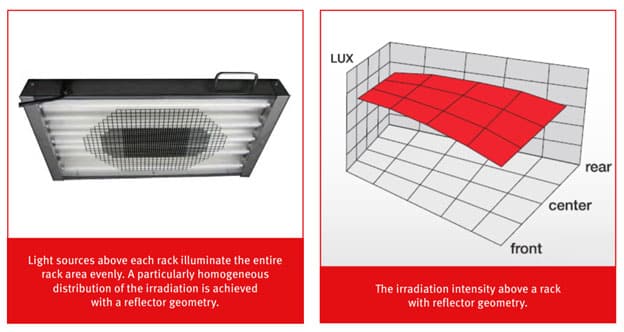
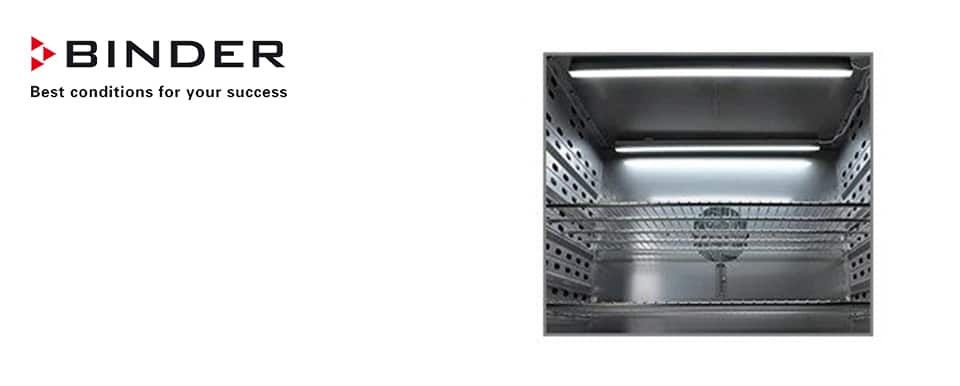
For photostability testing according to ICH Q1B, the light source, illumination level, and sensor types (spherical and planar sensors) are of decisive importance.
The above light sources and illumination levels are specified with exact test durations. Visible light (VIS in ISO 10977 (1993)) must achieve an exposure time of at least 1,2 million lux hours, and near-ultraviolet (320nm to 400nm) must be at least 200 Wh/m2.
Crucial is the distance to achieve the illumination intensity specified by the manufacturer, for example: VIS 8,750 lx or UVA 1,1 W/m2. The greater the distance to the light source, the lower the illumination intensity and the longer the exposure time.
The measuring system is described in the ICH Q1B guideline. For planar sensors, photostability is influenced by the liquid inside the glass tube.