Reliability of analytical results: sources of errors and how to overcome them

Table of contents
RELIABILITY OF ANALYTICAL RESULTS: WHERE DO ERRORS COME FROM AND HOW TO OVERCOME THEM?
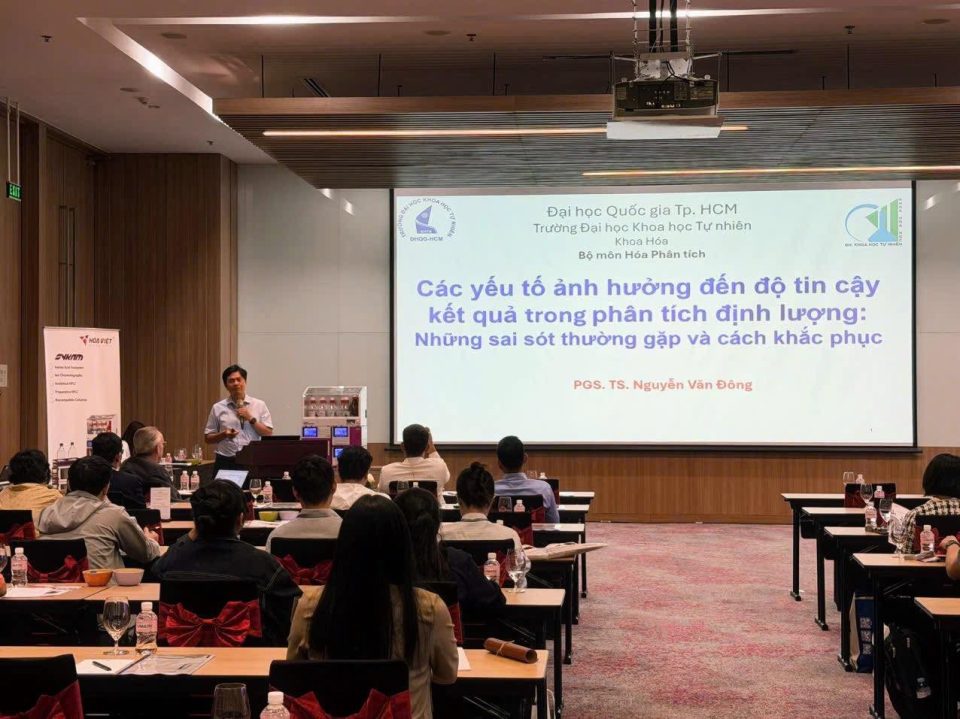
At the Sykam & Hoa Viet Seminar on 11/03/2026, guests will have the opportunity to hear extremely dedicated insights from Assoc. Prof. Dr. Nguyen Van Dong – one of the leading experts in analytical chemistry.
He will present the topic: "Professional perspectives on factors affecting the reliability of quantitative analysis results: Common errors and solutions".
In quantitative analysis, especially with complex chromatographic systems like Amino Acid analyzers, even a small deviation can lead to major consequences. Assoc. Prof. Dr. Nguyen Van Dong pointed out:
Common errors: From sample preparation, solvent selection to optimizing instrument parameters.
Influencing factors: Hidden "variables" during operation that technicians sometimes unintentionally overlook.
Troubleshooting solutions: A systematic approach to controlling errors, ensuring repeatability and accuracy of results.
The presentation not only provides academic knowledge but also practical, hard-won experience, helping laboratory personnel become more confident in optimizing analytical procedures at their facilities.
IN-DEPTH TOPIC: ARE YOUR ANALYTICAL RESULTS TRULY "ACCURATE"?
Following the success of the recent Sykam seminar, Hoa Viet would like to share more deeply about a topic emphasized by Assoc. Prof. Dr. Nguyen Van Dong – content that completely changed many technicians' perspectives on a test report.
In quantitative analysis, Accuracy is not simply a single number. It is the intersection of two aspects:
1. TRUENESS:
Ensured by: Standards and Reference Materials (RM, CRM).
Key factors: Calibration curves, Standard addition, and Internal standards.
The question is: Have you truly controlled the origin and quality of your reference materials?
2. MEASUREMENT UNCERTAINTY (Ux):
This is precisely the "unknown" that many labs unintentionally overlook.
It stems from: Significant figures, rounding rules, and error propagation throughout the operational process.
Estimating measurement uncertainty (GUM, NORDTEST) is the true benchmark of prestige and reliability for an ISO/IEC 17025 accredited laboratory.
Message from the expert: A mean analytical result (X) becomes meaningless without its measurement uncertainty (Ux). Understanding the origins of these errors not only helps troubleshoot technical issues but also optimizes lab operating costs.
Are you facing difficulties in calculating Measurement Uncertainty or optimizing calibration curves? Leave a comment or message us directly; the technical team of Hoa Viet and experts are always ready to support you!
Original post on the fanpage of Hoa Viet Co., Ltd. on 10/03/2026.